
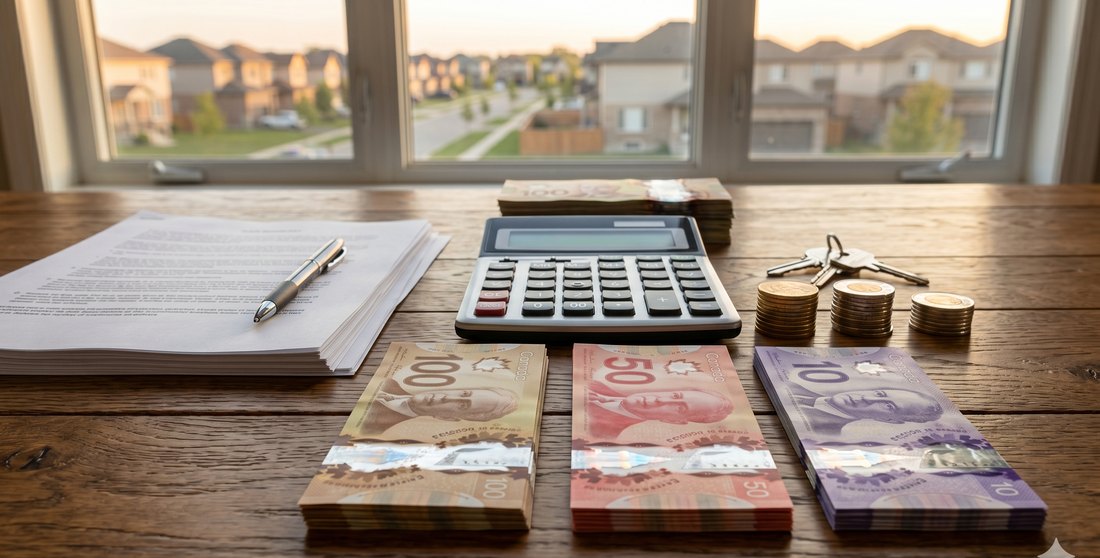
If you’re selling or buying a home in Canada, the real estate commission is one of the biggest costs in the whole deal, and most people never stop to ask exactly how much it is, who pays it, or whether any of it can come back to them. Here’s a plain, honest look at what commissions really cost, why the numbers are more flexible than you might think, and how a cash rebate can return part of that money to your pocket.
How much is a real estate commission in Canada?
There is no fixed rate set anywhere in the country. A common full-service total works out to around 5% of the sale price, though it varies quite a bit, roughly 3.5% to 5% in most markets. Some provinces use tiered structures, for example a higher percentage on the first $100,000 of the price and a lower one above that. On top of the commission you also pay GST or HST, so the figure you hear quoted is market convention rather than a set price.
Are commissions regulated or fixed by law?
No. Commissions are not regulated in any province, and they are always negotiable. Brokerages set their own fees, and federal competition law actually prohibits price-fixing among them. So while 5% is the number you’ll hear most often, nothing requires it. You’re free to discuss the rate, the structure, and exactly what’s included before you sign anything.
Who actually pays it, the buyer or the seller?
In most Canadian transactions, the seller pays the full commission out of the proceeds of the sale. The listing brokerage then typically shares a portion with the buyer’s brokerage, with a common split of about 2.5% to each side. That split can vary and be negotiated too, but the key point for buyers is reassuring: the commission is already built into what the seller pays, so it isn’t an extra cheque you write at closing.
What does that look like in real dollars?
The percentages can feel abstract, so it helps to put real numbers to them. On a $700,000 home at a 5% total commission, that’s about $35,000 before tax, often split roughly $17,500 to the listing side and $17,500 to the buyer’s side, plus GST or HST. On a $500,000 home at the same rate, it works out to about $25,000. These are real, meaningful sums, which is exactly why it’s worth understanding where the money goes and whether some of it can come back.
Hasn’t something been changing around commissions lately?
Yes, there has been a lot of discussion in the industry. In the United States, a major legal settlement changed how buyer-agent fees are disclosed to clients. Here at home, the Competition Bureau has had an open investigation into industry commission and cooperation rules since 2024, which it expanded in early 2026, and a 2025 class-action settlement touched on the same issues. For now, the core rules and the roughly 5% convention remain in place in Canada, but transparency around commissions is clearly getting more attention.
So how can a buyer get some of that money back?
Through a cash rebate. Because the buyer’s-side commission is already part of what the seller pays, an agent can choose to keep a smaller share and return the rest to you after closing. Buyers commonly receive somewhere in the range of 1% to 1.5% of the purchase price, which can add up to thousands of dollars, all without giving up full representation or service. The cash back is a genuine bonus on top of working with a strong agent, never a reason to settle for a lesser one.
Does taking a rebate cost me anything or affect my taxes?
A rebate doesn’t add anything to your costs. It’s simply a portion of an existing commission returned to you, usually a few weeks after closing, and spelled out in writing in your buyer agreement before you begin. For a principal residence, the rebate is generally treated as reducing your purchase cost rather than as taxable income. Tax situations differ from person to person, so it’s always wise to confirm the details with your own accountant.
The bottom line
Real estate commissions in Canada are large, negotiable, and far less fixed than most people assume, with around 5% as a common starting point rather than a rule. The seller pays, the cost is shared between both sides, and on a typical home that can mean tens of thousands of dollars. A cash rebate lets an eligible buyer return part of that money, potentially thousands of dollars, while still working with a vetted, experienced agent and keeping full service. Knowing how the numbers work is the first step. Asking what you might be eligible for, with everything confirmed in writing, is the next.
Sources: Rates.ca, Real Estate Commissions in Canada (rates.ca/resources/real-estate-commissions-in-canada) · WOWA, Real Estate Commission Rebates for Buyers (wowa.ca/real-estate-rebate-buyer) · Competition Bureau Canada, Investigation into CREA’s policies, October 2024 (competition-bureau.canada.ca) · Competition Bureau Canada, Investigation expanded to Greater Vancouver, January 2026 (competition-bureau.canada.ca) · CBC News, Cashback rebates can save thousands (cbc.ca)